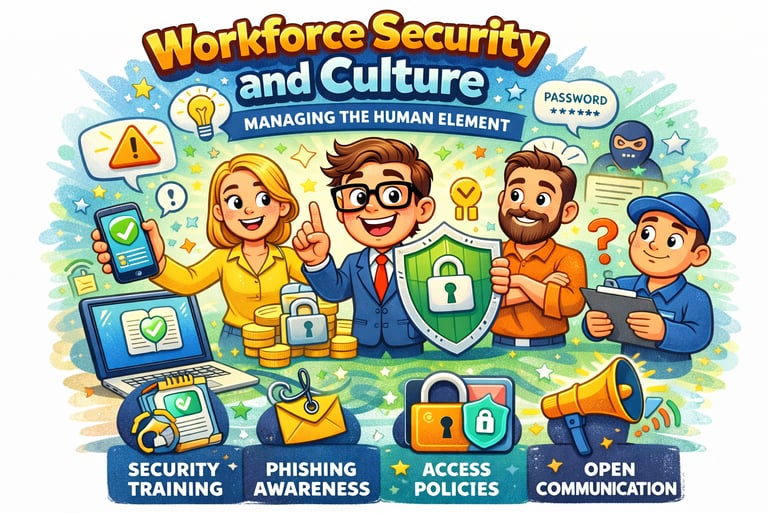
Workforce Security & Culture
While technical defenses are vital, human error is responsible for approximately 95% of all cybersecurity incidents. Employees are often the primary target for attackers because they represent the "weakest link" in the security chain. This guide explains how to transform your workforce from a vulnerability into a "human firewall" that serves as your most important line of defense.
1. Build a Culture of Security from the Top Down
Cybersecurity is not just an IT problem; it is a top-level business risk that requires commitment from leadership.
Set the Tone: C-level buy-in is critical; when the boss takes security seriously, the rest of the firm follows.
Lead by Example: Business leaders should model good security behaviors and prioritize these risks in regular management meetings.
Shared Responsibility: Foster an environment where security is everyone's job, regardless of their role.
2. Implement Continuous, Engaging Training
Static, once-a-year training is rarely effective. A robust program focuses on altering staff behavior rather than just checking a compliance box.
Identify the Big Three: Training should prioritize the most common threats: phishing, social engineering, and poor password habits.
Simulated Phishing: Conduct regular "phishing campaigns" to test employees' ability to spot malicious links in a safe environment.
Tailored Content: Adjust training topics based on the employee's role (e.g., finance staff should focus on invoice redirect scams).
Use Rewards, Not Shame: If an employee fails a simulation, use it as a learning opportunity rather than a reason for discipline.
3. Enforce the "Principle of Least Privilege"
Access control is the process of regulating who can enter your business's "digital doors".
Least Privilege: Give users the bare minimum permissions they need to perform their work.
Separate Admin Accounts: No one should use an account with "Administrator" rights for daily tasks like email or web browsing.
Individual Accounts: Avoid shared logins; individual accounts ensure accountability and make it easier to track malicious activity.
4. Transition from Passwords to Passphrases
Weak or reused passwords are a leading cause of small business breaches.
The Passphrase Advantage: A passphrase (e.g., 'crystal onion clay pretzel') is longer, harder for criminals to crack, and easier for employees to remember.
Use Password Managers: Encourage the use of a virtual safe to create and store unique, complex passwords for every important account.
5. Establish Clear Reporting Procedures
An emergency plan reduces the impact of an attack by helping staff take immediate action.
Process to Report: Ensure every employee knows exactly who to contact (and how) if they click a suspicious link or lose a device.
Offboarding Protocol: When an employee leaves, revoke their access and delete their accounts immediately to prevent "insider threats".
Workforce Security Checklist
[ ] Leadership-driven security policy documented and communicated to all staff.
[ ] Cybersecurity training integrated into the onboarding process for all new hires.
[ ] Phishing simulations conducted at least bi-annually to test staff awareness.
[ ] Principle of Least Privilege applied to all folders, databases, and mailboxes.
[ ] Password policy enforced that requires long, unique passphrases.
[ ] Employee exit checklist implemented to ensure all access is revoked upon departure.
Next Step: With a secure workforce culture established, you must look outward to your legal obligations and long-term business continuity. See Guide 4: Governance, Compliance, and Resilience Planning.
© 2026 All rights reserved.