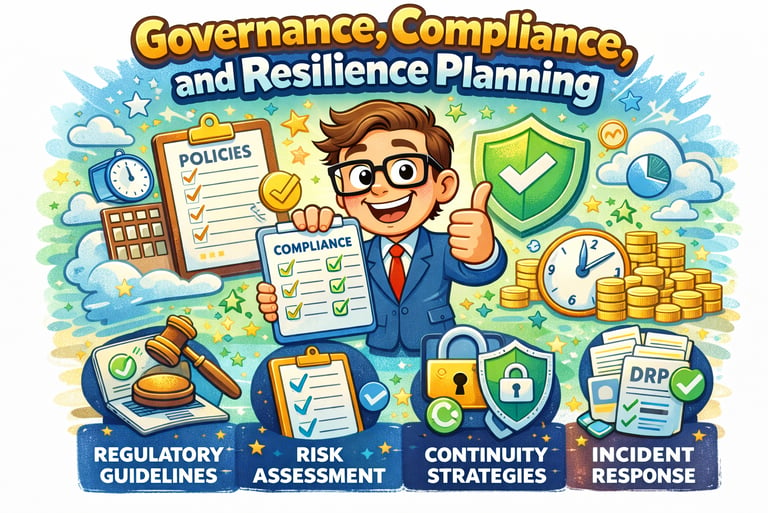
Governance, Compliance, and Resilience Planning
This final guide helps you shift from a reactive "survival mode" to a proactive business posture. By treating cybersecurity as a top-level business risk rather than a technical problem, you can satisfy legal obligations, win larger contracts, and ensure your business survives even a major attack.
1. Governance: Leading from the Top
Cybersecurity starts with the business owner, not the IT department.
Establish Clear Roles: Assign responsibility for cybersecurity to a specific person within the organization who acts as the "go-to" for security issues.
Formalize Policies: Document your rules for internet usage, social media, and remote work so employees understand their boundaries and responsibilities.
Risk-Based Budgeting: Instead of buying every tool available, conduct a risk assessment to identify your most critical assets and prioritize your budget where it will have the most impact.
2. Compliance: Understanding Your Legal Obligations
Many SMBs are unaware of the legislation that applies to them, which can lead to massive fines—sometimes up to $50 million or 4% of global turnover for serious breaches.
Mandatory Breach Notification: In many jurisdictions, such as Australia (NDB Act) and Europe (GDPR), businesses are legally required to notify regulators and customers if sensitive data is stolen.
Identify Applicable Laws: While some small businesses have exemptions, those handling health records or reaching specific revenue thresholds (e.g., $3M in Australia) must comply with privacy acts.
Software Compliance: Ensure all business software is properly licensed; using pirated or unlicensed software increases legal risks and often contains hidden malware.
3. Incident Response and Resilience: Planning for the "When"
You will not be judged for suffering a breach, but you will be judged on how well you respond.
Create a Response Plan: Develop a simple document listing exactly who to call (IT support, bank, insurance, lawyers) and how to communicate the breach to customers and the press.
Conduct Tabletop Exercises: Once a year, sit down with key staff and run a simulation—such as "what do we do if a laptop is stolen today?"—to identify gaps in your plan.
Business Continuity: Ensure you have a plan to keep operations running (even manually) if your primary systems go offline for days or weeks.
4. Supply Chain Risk: Protecting Your Partnerships
As large enterprises harden their defenses, they increasingly view their smaller partners as a "backdoor" into their networks.
Vendor Vetting: Before hiring a cloud provider or third-party vendor, ask for evidence of their security practices and include security clauses in your contracts.
Competitive Edge: Many larger firms now require cybersecurity certifications (like Cyber Essentials) as a prerequisite for winning tenders.
Cyber Insurance: Consider a policy that covers breach notification costs, data restoration, and even third-party liability if a vendor’s breach affects your business.
Governance and Resilience Checklist
[ ] Specific person assigned as the cybersecurity lead for the firm.
[ ] Written security policy (Internet use, password rules) signed by all staff.
[ ] Legal obligations identified regarding data breach reporting.
[ ] Incident Response Plan printed out and kept in a physical location.
[ ] Cyber insurance policy reviewed to ensure it covers ransomware and recovery.
[ ] Vendor audit completed to ensure partners have access only to necessary data.
Conclusion: You have now completed the 4-part SMB Cybersecurity Guide. By mastering Technical Hygiene, Data Management, Workforce Culture, and Governance, you have built a comprehensive defense that protects your customers, your data, and the future of your business.
© 2026 All rights reserved.